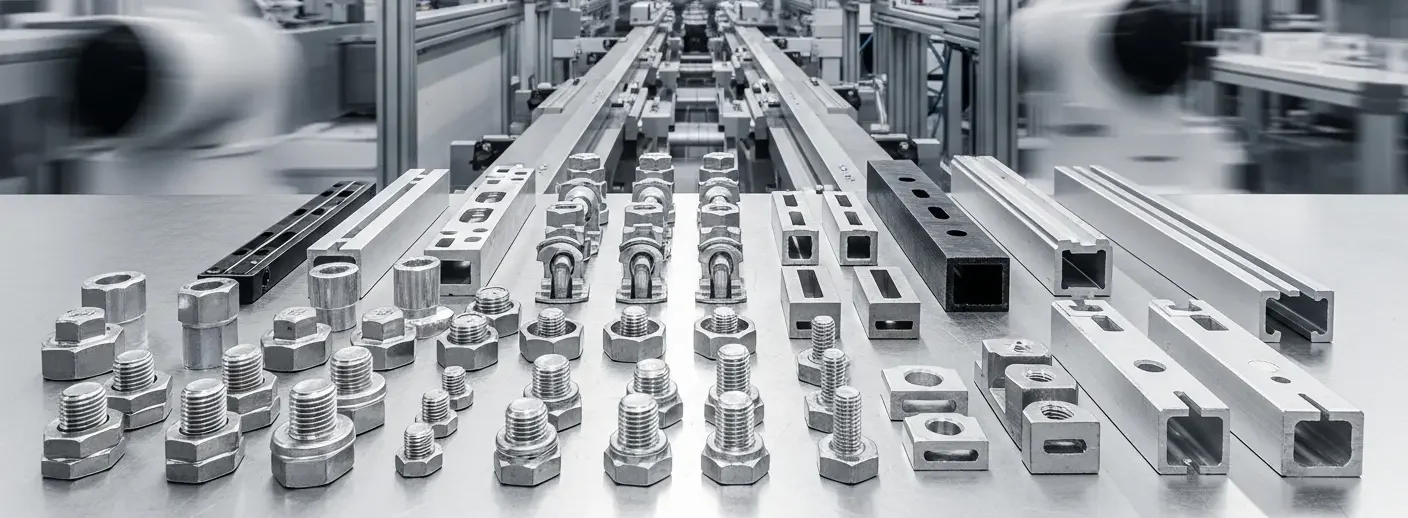
Yes. We retain the original tooling and product specifications, and keep supplying original spare parts such as rails, clamps and fasteners on a long-term basis. These parts are fully compatible with the first batch delivered. You may place follow-up orders in batches whenever the project requires, so there is no need to worry about spare parts not matching later on.
Yes. Before dispatch we provide photos or videos of the loading process, the packing list and the factory quality inspection report, so that the goods can be checked against the order. If a third-party inspection (SGS, BV or similar) is required, it can be arranged in advance, and the inspection cost is borne by the buyer.

Steel structure supports carry a 10-year warranty, and aluminum alloy supports a 15-year warranty. Within the warranty period, replacement parts are supplied free of charge for quality defects that are not caused by human damage.
Please provide on-site photos and the packing list within seven days of delivery. Once our side confirms that the issue is our responsibility, the corresponding parts will be replaced free of charge with the next order; the damaged pieces do not need to be returned.
An installation manual and instructional videos are supplied with the goods. Our technical support team replies within 24 hours on working days, and for complex projects we can arrange remote guidance from an engineer.
Hot-dip galvanized supports are designed to be maintenance-free. Under normal service conditions no regular anti-corrosion treatment is required, and corrosion performance remains stable throughout the service life. In particularly corrosive environments, a simple visual inspection at regular intervals is enough, and this does not affect normal use.
No. The fasteners we supply with the supports follow the same corrosion protection system: hot-dip galvanized bolts are paired with hot-dip galvanized supports, and in highly corrosive environments the fasteners are upgraded uniformly to stainless steel. This prevents galvanic corrosion caused by contact between dissimilar metals at source. During installation, simply avoid direct contact with other metals such as copper or aluminum as instructed in the manual.
Steel structure supports adopt the hot-dip galvanizing (HDG) process. The average zinc coating thickness is at least 65 micrometers, meeting the ISO 1461 standard, and the anti-corrosion service life can reach more than 25 years in outdoor exposure.
The hot-dip galvanized coating remains stable at temperatures as low as minus 40 degrees Celsius, with no brittle cracking. Projects we supply to Russia are specified for severe cold climates, and the zinc coating thickness is increased by 10 to 15 percent compared with the conventional standard.
For coastal and highly corrosive environments, aluminum alloy supports are recommended first. If steel supports are selected, the zinc coating thickness should be increased to at least 80 micrometers and matched with stainless steel fasteners; the salt spray test can then exceed 1,000 hours.
The support structure itself can be installed normally at low temperatures and is not affected by the cold. Auxiliary materials such as sealant and waterproof washers should be low-temperature grade below minus 5 degrees Celsius, and work should be avoided on rainy or snowy days. For winter construction, take appropriate anti-slip measures and follow the sequence in the installation manual.
The standard design covers wind speeds of 30 to 40 meters per second and a snow load of 0.5 kilonewtons per square meter. We can carry out a dedicated design based on the actual wind and snow parameters at the project site, to meet the requirements of the Russian SNiP building codes.
The structural steel uses Q235B or Q355B low-temperature grades, with Charpy impact test temperatures of minus 20 degrees and minus 40 degrees Celsius respectively. Brittle fracture does not occur in such extreme cold, and the material is suitable for most regions of Russia.
The structure can be designed for seismic resistance according to the seismic zoning requirements of Russia, with a design fortification intensity of up to degree 9. A complete structural calculation report is provided for local submission and approval.
Yes. The choice depends on the soil conditions and the local frost depth. Screw piles suit frozen soil, sandy soil and projects requiring fast construction; concrete strip or isolated foundations suit soft soil and heavy loads; ballasted foundations can be used on rock ground or leased rooftops. Based on the site geological report and local frost depth, we provide foundation selection advice and the connection scheme between the supports and the foundation.
Yes. We are familiar with the European EN standards and the Russian SNiP building regulations. We can provide structural calculation reports and construction drawings that meet local requirements, and assist the buyer in passing local approval.
Proven solutions are available for color steel tile roofs, concrete roofs, flat roofs, sloped roofs and BIPV (building-integrated photovoltaics) facades, with dedicated clamps and waterproof accessories supplied accordingly.
Profile length, hole layout and surface color can all be customized to the buyer's requirements. OEM production is also supported, with the buyer's brand logo printed on the products.
Yes. After reviewing the module layout, array spacing and project loads, we produce the support layout drawings, detailed node drawings and installation instructions, ensuring compatibility with the module clamps and foundation interfaces. These drawings can be used directly on site.
Regular specifications such as standard rails, mid and end clamps, and common bolts are kept in stock. They are dispatched within three to five working days after payment is received.
Custom projects (special dimensions, special colors or non-standard structures) have a production cycle of 25 to 35 days, depending on order quantity and complexity.
By sea to Saint Petersburg it takes about 35 to 45 days; by rail (China Europe freight train) to Moscow about 18 to 25 days; by road transport about 15 to 20 days. The shipping method can be chosen according to the buyer's schedule.
The MOQ for standard products starts at 100 sets; customized products are quoted separately per project. Mixed loading in shared containers is supported, so buyers with small quantities can combine their goods with other orders to save freight.
Packaging can use moisture-proof stretch film together with wooden pallets or steel frames, suitable for sea and rail transport. Individual piece weight, dimensions and shipping marks are made to the buyer's logistics requirements, and a packing list with weight details is provided before dispatch.
You can contact us at any time. We look forward to your inquiry!